POSTHIERARCHICAL ANALYSIS · 016
Can an institution’s eyes and ears remain voiceless?
A posthierarchical analysis of Ugnė Tulaitė and Juozas Ruzgys’s conversation with Karilė Mozerytė, volunteer coordinator at the MO Museum
Terms marked with ? are explained without leaving the article.
MO volunteers see what the administration cannot see from its offices: visitors’ immediate reactions, discomfort, curiosity, and moments of misunderstanding. Yet if this experience only travels upward while the decision comes back down, the institution becomes more responsive but not yet posthierarchical.
Publication: Bernardinai.lt
Video: conversation on YouTube
SHORT EXPLAINER · 1 MIN 16 SEC
The museum’s blind spot
Volunteers and visitors are often the first to see how a museum experience works in practice. Their knowledge becomes part of the museum’s collective intelligence only when it enters a shared search for solutions.
- Volunteers see the museum from the visitor’s position.
- Passing feedback upward does not yet create a voice in decidement.
- The hierarchical centre remains the filter of ideas.
- Collective intelligence turns observation into participation in decidement.
A community that sees the museum up close
Ugnė Tulaitė and Juozas Ruzgys’s conversation with Karilė Mozerytė, the MO Museum’s coordinator of visitor experience and visual communication, is more than an invitation to volunteer. It reveals a small but significant part of a cultural institution’s structure: the everyday connection between the museum experience designed by the administration and the people who encounter it in the exhibition hall.
The MO volunteer community includes people from twelve to eighty years old. They look after spaces, communicate with visitors, work at the information desk, assist at events, with children, in archives and databases, take photographs, and, once prepared, can become volunteer guides. Volunteering lasts for a six-month season, so the selection process looks not only for a formal need to complete community-service hours, but also for inner motivation and readiness to belong to a community.
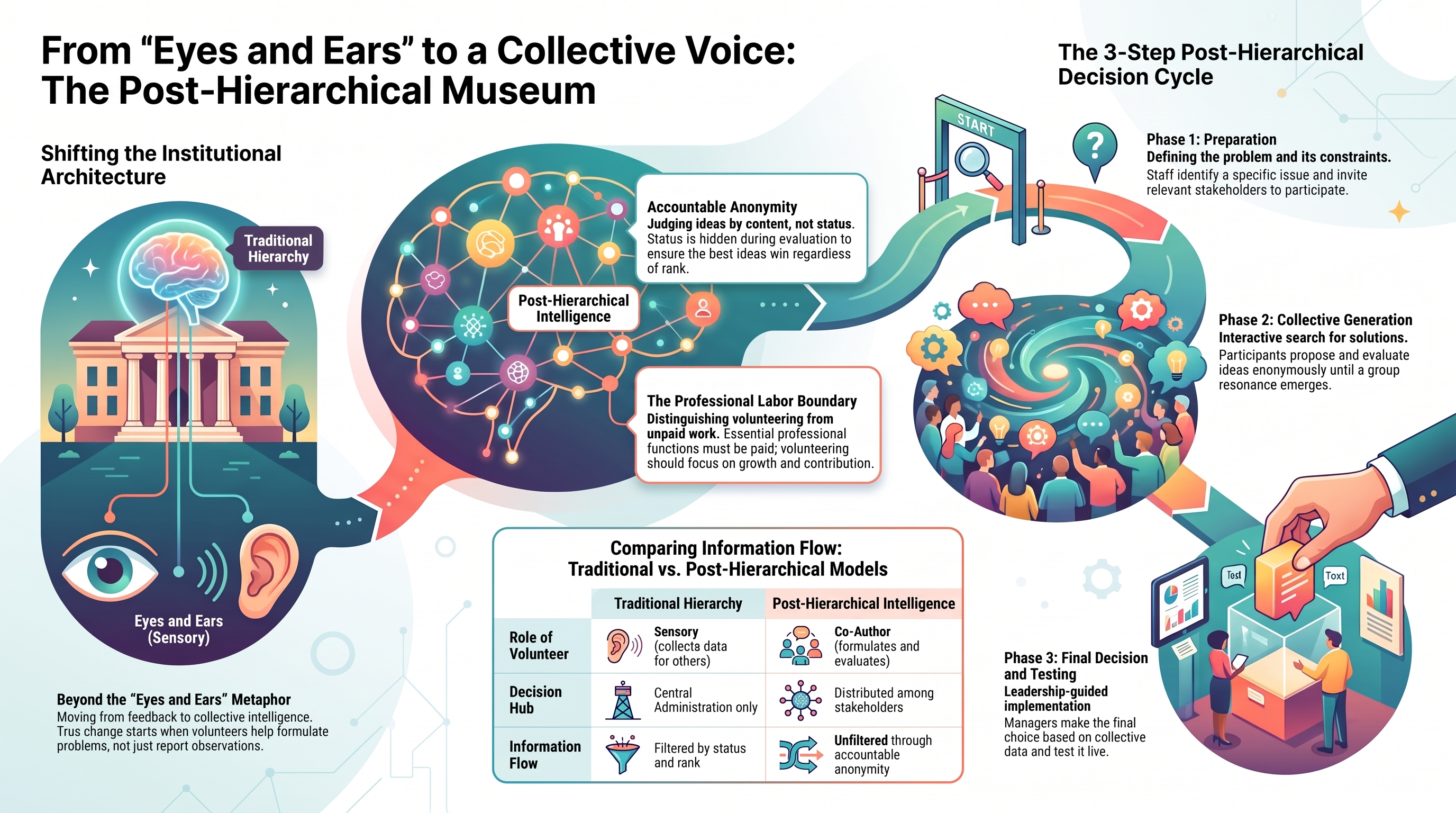
The article’s core is concentrated in one metaphor: volunteers are the museum’s “eyes and ears”. The administration creates exhibitions and visitor experiences, while volunteers see how people receive them and pass on feedback. This metaphor reveals both the model’s greatest strength and its institutional limit.
Context: a cultural institution between participation and work
A contemporary museum is no longer merely a repository where professionals select objects and the public quietly views them. A museum seeks to be a place of education, encounter, discussion, and belonging. A volunteer therefore occupies a distinctive position: neither merely a visitor nor an ordinary employee. At the same time, the volunteer helps the institution function, learns, builds relationships, and experiences at close range how the museum’s intentions work in reality.
This intermediate position creates both an opportunity and a risk. The opportunity is that volunteers can connect the institution with very different social groups. The risk is that the language of community may conceal regular work that is necessary to the institution and should therefore be paid. The authors of the conversation do not avoid this tension: they ask directly where volunteering ends and unpaid work begins. It is an important question that cultural institutions should not leave to goodwill alone.
Yet there is a third question, one raised less often. Even if volunteering is meaningful to both sides and does not replace salaried staff, what power does the knowledge accumulated by volunteers have within the institution? Do volunteers merely pass information to those who decide, or can they participate in decidement?
What the conversation shows particularly well
Different generations do not merely spend time together; they learn from one another
The age difference between the youngest and oldest volunteers is almost seven decades. This creates a rare space of horizontal relationships in which knowledge does not travel in only one direction and age alone does not determine who is the teacher and who is the learner.
Activities are matched to a person’s abilities and interests
Someone interested in photography is offered photography tasks; someone who enjoys working with children can help at camps; and someone who wants to go deeper can progress towards becoming a volunteer guide. A person is not reduced to a unit of available labour.
Volunteering is understood as a continuing relationship
The six-month season, selection process, and emphasis on inner motivation protect the programme from the logic of a one-off work party. Long-term volunteers accumulate institutional memory and sometimes know the museum better than new employees do.
Mentoring distributes everyday care
Experienced volunteers help newcomers when one coordinator can no longer personally accompany around eighty people. This is already the beginning of decentralisation: part of the capacity to integrate new members is transferred to the community itself.
The institution recognises the value of experiential knowledge
Volunteers do more than perform tasks. They observe the encounter between visitors and the exhibition and can therefore notice what a curator’s concept, attendance statistics, or an administrative meeting may fail to reveal.
Where the conversation’s argument ends and posthierarchical analysis begins
Volunteers are a diverse, motivated community that matters to the museum. They help visitors, learn, build relationships with one another, and provide the administration with valuable feedback.
The movement of information from the periphery to the centre does not yet change the decision architecture. A community becomes a co-author of the institution’s direction only when it can formulate problems, create and evaluate alternatives, and participate in decisions whose consequences it will experience.
Being an institution’s eyes and ears does not yet mean having a voice in deciding where the institution should go.
shift: not passing experience on, but bringing it into decidement
The metaphor of “eyes and ears” gives volunteers a cognitive function, yet the deciding “mind” remains elsewhere. Volunteers notice, listen, and report. The administration receives the information, selects and interprets it, and then decides what to change. This may be a responsive, professional, and benevolent hierarchy, but its centre remains unchanged.
Posthierarchy does not mean that volunteers should vote on every artwork, replace curators, or take over the administration of the museum. Different decisions require different competences and responsibilities. But a position should not automatically confer a monopoly over deciding which experience matters, which problem deserves attention, and which alternative will be considered at all.
The real change would therefore begin not with another survey but with shared . Volunteers’ observations would become not raw material for the centre but a starting point for jointly formulating the problem. Administrators, curators, educators, artists, volunteers, and visitors could see one another’s proposals, evaluate them, and test whether an individual observation reveals a broader pattern.
Feedback is not yet shared governance
Feedback is usually incorporated only after the most important boundaries have already been set: the exhibition has been created, the visitor journey designed, volunteer roles defined, and the survey questions formulated by the institution itself. A participant can say how a decision works but often cannot change the question that decision was intended to answer.
Individual accounts also have unequal visibility. A forcefully expressed opinion, a frequently repeated complaint, or an observation made by someone close to the coordinator may seem more important than a quiet but systemically significant signal. The hierarchical centre inevitably becomes a filter: even when acting in good faith, it decides what to hear, how to group it, and what to prioritise.
A collective intelligence environment would avoid two extremes: neither would the loudest single opinion become the museum’s direction, nor would the administration alone decide which opinion to treat as meaningful. Participants could evaluate proposals under conditions of accountable anonymity, while the system would reveal not only an average but also agreement, polarisation, and the structure of different groups’ experiences.
The boundary between volunteering and paid work is a question of institutional architecture
Whether an activity is genuinely volunteering depends not only on a person’s goodwill or on the sense of community, knowledge, and contacts they gain. If a task is performed regularly, according to a set schedule, is necessary to the museum’s everyday operation, and replaces work that would otherwise be done by an employee, it approaches a paid professional function. The language of community does not remove the question of remuneration.
In a posthierarchical institution, this boundary would not be set by the administration alone. Before the season, employees and volunteers would use collective decidement to assess the map of activities. They would distinguish learning, civic contribution, and freely chosen assistance from permanent professional functions. The actual time devoted to an activity, the responsibility involved, the museum’s dependence on that activity, and the possibility of giving it up without adverse consequences would all be assessed.
The boundary, once set, would not be final. In a collective intelligence environment, employees, volunteers, visitors, and others interested in the museum’s success could propose reviewing it when new arguments, experiences, or ideas emerge. If an activity previously regarded as voluntary becomes regular, necessary to the institution, or replaces a professional function, its status and remuneration must be reconsidered.
At the same time, remuneration for work necessary to the museum must be distinguished from a reward for voluntary contribution to collective decidement. Volunteers, museum visitors, and others interested in its success may be rewarded with museum publications, other valuable items, event tickets, gifts, or cash prizes.
The collective intelligence platform accounts for each participant’s contribution: the substantive proposals they submit and their ability, through evaluating other ideas, to help the group recognise the most valuable solutions. The points accumulated in a project make it possible to determine transparently who made the largest contribution, who ranked second, and how the remaining contributions compare. Such a reward recognises participation in the shared search for a solution but does not replace remuneration for a professional function.
Posthierarchy cannot mean giving people more responsibility without also providing the opportunity to participate in decidement, the resources they need, and remuneration for work on which the institution depends.
This would protect both volunteers and the idea of volunteering itself. Voluntary contribution would remain free, meaningful, and supplementary to the museum’s work instead of becoming its cheap labour.
Competence remains, but status no longer decides in advance
Museum decisions are not all alike. Conserving an artwork requires specialist knowledge; staff schedules require responsibility for organising work; visitor experience requires both professional research and everyday contact; and strategic direction requires a broader understanding of the public value the institution creates. Posthierarchy therefore does not propose mechanically equalising every voice.
It proposes separating competence from position. A long-serving volunteer may be better than a new administrator at recognising recurring visitor difficulties. A young visitor may notice a barrier in digital communication that an experienced curator does not see. A curator may justify a decision through knowledge of art history and exhibition dramaturgy. Each contribution should be evaluated by its content and its capacity to help the group recognise the most valuable solution, not by the contributor’s place in the organisational chart.
would temporarily separate a proposal from the author’s status. At the same time, the system would preserve accountability: it would account for the participant’s contribution and, over time, show whose evaluations most often resonate with what the group ultimately recognises as most valuable.
How museum decidement could work
A posthierarchical process consists of three parts: preparation for , the decidement itself, and what happens after it ends.
1. Preparing for collective decidement
First, one specific problem is selected. It may emerge from the observations of volunteers and visitors, employees’ experience, surveys, or other data.
The information needed for decidement is then gathered, legal, professional, and financial constraints are established, and people who understand the problem or experience the consequences of related decisions are invited.
Collective decidement has not yet begun at this stage. The museum is only preparing the problem, participants, and conditions.
The boundary between work and volunteering should be provisionally defined before a specific project begins, but it is not immutable. If new arguments or proposals emerge, reviewing this boundary may become the problem addressed by a separate collective decidement project.
2. Collective decidement
Collective decidement begins when participants enter a shared, interactive search for a solution.
They first evaluate insights and proposals already submitted by other participants. Only then may each participant submit one clearly formulated idea. Ideas and their evaluations are submitted under conditions of , so their content—not the author’s position, age, or prominence—is evaluated.
The system accounts for participants’ contributions, shows which alternatives achieve the strongest , and reveals where the group agrees and where the problem still needs to be examined afresh.
Collective decidement ends when the ideas have been gathered and evaluated and the system presents a collective view of the alternatives. Because the museum retains a hierarchical structure and is not an organisation, the right to make the final decision does not automatically pass to decidement participants. Unless agreed otherwise in advance, the final decision is made by managers and curators who are paid for their work and responsible for the museum’s success.
3. What happens after collective decidement ends
The results of decidement are passed to the museum’s managers. Unless agreed otherwise in advance, they make the final decision, taking into account participants’ proposals, their evaluations, and the resonance shown by the system.
The chosen decision is implemented or first tested on a small scale. The museum observes whether the intended change has been achieved and reports the results to all participants.
If the test reveals new circumstances or problems, a new decidement cycle begins. Implementation and impact measurement, however, are no longer collective decidement; they are a test of its result in reality.
A concrete museum example
Suppose the problem were that some visitors to a contemporary art exhibition did not feel prepared to ask questions or interpret what they saw:
- during preparation, the problem would be refined, observations gathered, and visitors, volunteers, guides, educators, curators, and artists invited;
- during collective decidement, they would use the to propose and evaluate different ways of changing the visitor experience;
- after decidement ended, the museum’s managers, unless agreed otherwise, would choose which solution to implement, and its impact would be tested in the exhibition.
Preparation → collective decidement → managers’ decision → implementation and testing.
VIDEO ESSAY · 9 MIN 31 SEC
Posthierarchy in museums
An extended visual explanation of how a museum can move from collecting observations to a process in which distributed experience helps formulate problems, create and evaluate alternatives, while managers use the collective decidement result to make a responsible final decision and test its effects.
From helping the museum to co-creating the museum
The MO volunteering model already contains several elements important to posthierarchy: interaction between generations, recognition of volunteers’ abilities, the gathering of experiential knowledge, and mentoring through which part of everyday care is transferred to the community. A transition to shared decidement would therefore not require dismantling what already works. It would extend a movement already under way.
Such a project would not make the whole museum posthierarchical in a single season. It would, however, change the volunteer’s position. A volunteer would no longer be merely someone who helps deliver an already designed experience and reports on it to the administration. They would become one of the people able to help determine what kind of experience is worth creating.
AUDIO ESSAY · 20 MIN 41 SEC
Status is not competence
An audio exploration of the article’s central institutional distinction: the value of an idea should not depend on its author’s age, title, or visibility, yet separating status from evaluation does not remove professional competence, responsibility, or the managers’ formal right to make the final decision.
Conclusion: an institution begins to hear only when it allows a response
Tulaitė and Ruzgys’s conversation reveals a lively, diverse, and meaningful MO volunteer community. It is especially valuable that volunteers are seen as more than assistants: their knowledge, relationships, different abilities, and capacity to show the administration visitors’ real experience are recognised.
Yet “eyes and ears” is also a cautionary metaphor. If the community merely gathers signals while the centre alone interprets them and turns them into decisions, participation makes the hierarchy more responsive but does not change its structure.
A posthierarchical museum need not abandon professionalism, curatorship, or administrative responsibility. It must abandon the assumption that only the centre holding formal positions can determine what deserves to be addressed. Only then will volunteers become not merely the institution’s sensory organs but part of its collective intelligence.
Map of the article’s argument
flowchart TD
          A["Administration creates exhibitions and visitor experiences"] --> B["Volunteers interact with visitors"]
          B --> C["Observe experiences and provide feedback"]
          C --> D{"How are solutions sought?"}
          D -->|"Within the administration"| E["The centre selects problems and alternatives itself"]
          D -->|"Through collective decidement"| F["Volunteers, employees, creators, and visitors formulate problems"]
          F --> G["Alternatives are created and evaluated under accountable anonymity"]
          G --> H["The system presents the collective evaluation of alternatives"]
          H --> I["Managers make the final decision"]
          I --> J["Test results may begin a new cycle"]
          classDef conventional fill:#f3f1ec,stroke:#9b978f,color:#25261f
          classDef post fill:#fff8f4,stroke:#a93b2b,color:#25261f,stroke-width:2px
          class A,B,C,D,E,I,J conventional
          class F,G,H post