POST-HIERARCHICAL ANALYSIS · 021 ·
How a Literary Prize Makes a Book ‘the Best’
France’s Prix Goncourt and the power to decide which novels get read
Select a term marked ? for a short explanation.
A literary prize changes no sentence in a novel. It changes the odds that someone will read that sentence. Who should decide which books get that chance?
France’s Prix Goncourt carries a cash award of ten euros. The winning novel, meanwhile, can sell hundreds of thousands of copies. An essay for LRT, Lithuania’s public broadcaster, traces the history behind that disparity. A small jury’s literary judgements carry enormous commercial weight. Publishers’ interests, the historical dominance of men on the jury and a writer’s reputation all figure in the account. [1]
Valdas Puteikis, ‘France’s Prix Goncourt: Behind the Scenes, Upsets and Paradoxes’, LRT.lt, 30 October 2026. Read the original in Lithuanian →
SHORT VIDEO · 1 MIN 21 SEC
How Collective Decidement Judges Literary Prizes
What would happen if a literary prize asked readers to make a case for a book?
- Readers answer questions about the works before joining the discussion.
- They offer a reading of their own and weigh one another’s arguments anonymously.
- After the award, readers can still explore the cases made for every book.
What does a literary prize actually reward?
One strength of the essay is the care it takes with the evidence. The repeated success of major publishing houses is worth examining. On its own, it proves nothing about corruption. That distinction gives us room to ask how an institution shapes literary taste even when nobody leans on a judge. [1]
Can the way a prize is decided systematically narrow the field of literature, even when everyone involved acts in good faith?
Imagine jurors who read closely, argue their cases and genuinely want to reward the finest novel before them. They may still move in the same professional circles, have learnt to admire the same techniques and know many of the same people. Some kinds of literary achievement will come more readily into focus for them than others.
Changing one juror does little to address that difficulty. Who gets into the room? Whose arguments reach it? And how does a roomful of different readings become a single decision?
The history of the Goncourt shows how questions of reputation, commercial interest and institutional authority enter into literary judgement.
How could a prize give a book, or an argument about it, a fair hearing when the names of the writer, critic and publisher already carry weight?
When recognition produces its own evidence
To say that a prize makes a book ‘the best’ is to distinguish two things that are easy to conflate. One is what the novelist achieves on the page. The other is the standing an institution can confer on that achievement.
A novel may already be remarkable on the morning the judges meet. By the end of the day its prospects of finding readers have changed. More people talk about it. Booksellers and reviewers turn to it. Interpretations that a handful of readers might once have shared begin to circulate in public.
Recognition can come to look like evidence for itself. The book attracts attention because the jury has declared it important. Later, the sheer volume of that attention is cited as further evidence of its importance.
Another novel from the same season may all but disappear. Somewhere between publication and the closing of the prize lists, hardly anyone took the time to make a case for it.
A jury therefore distributes more than honours. It distributes the chance to become part of a culture’s memory.
Readers have limited time. A critic who has read widely can be a valuable guide. The difficulty comes when one institution’s guide to a literary season starts to stand for the whole map.
What the judges read into a name
The novelist Romain Gary won the Goncourt twice, although its rules allow a writer to win only once. The second time, the name on the cover was Émile Ajar. The prize went to a writer the jury had already honoured. [1]
It is tempting to treat this episode as an experiment in literary reputation. A controlled experiment would have put the same text before judges under different names. Gary wrote different books. His story leaves the size of the effect open.
It does, however, raise a question most readers can recognise. When we open a book, how much room do we leave for surprise? How much of our attention goes into finding the writer we already think we know?
A familiar name can buy a novelist a little patience with a difficult opening. It can also close the book before the first page. ‘I know what he does.’ ‘She’s had her moment.’ Reputation works in both directions.
There is a practical consequence for a prize. Begin with the work and with the case a reader makes for it. Give both a chance to establish their worth before a reputation settles the matter.
A writer’s history, language or experience may be indispensable to an interpretation. Knowing why a writer chose a particular voice can help us hear it. Being told in advance how much to admire that voice does something quite different.
Whose name should readers see?
Withholding a novelist’s name and withholding the names of the people assessing a novel serve different purposes.
Removing a name may curb some preconceptions when judges are reading unpublished manuscripts. Once a novel is in print, its voice, plot or reviews can give the author away. Take off the jacket and many readers will still know whose book they are holding. For a prize that considers published works, the writer’s name should stay.
Readers assessing one another’s arguments have a different reason for anonymity. A researcher at the start of her career ought to be able to question a senior scholar’s reading. An eminent critic’s observation should earn its standing from what it helps other readers see in the text.
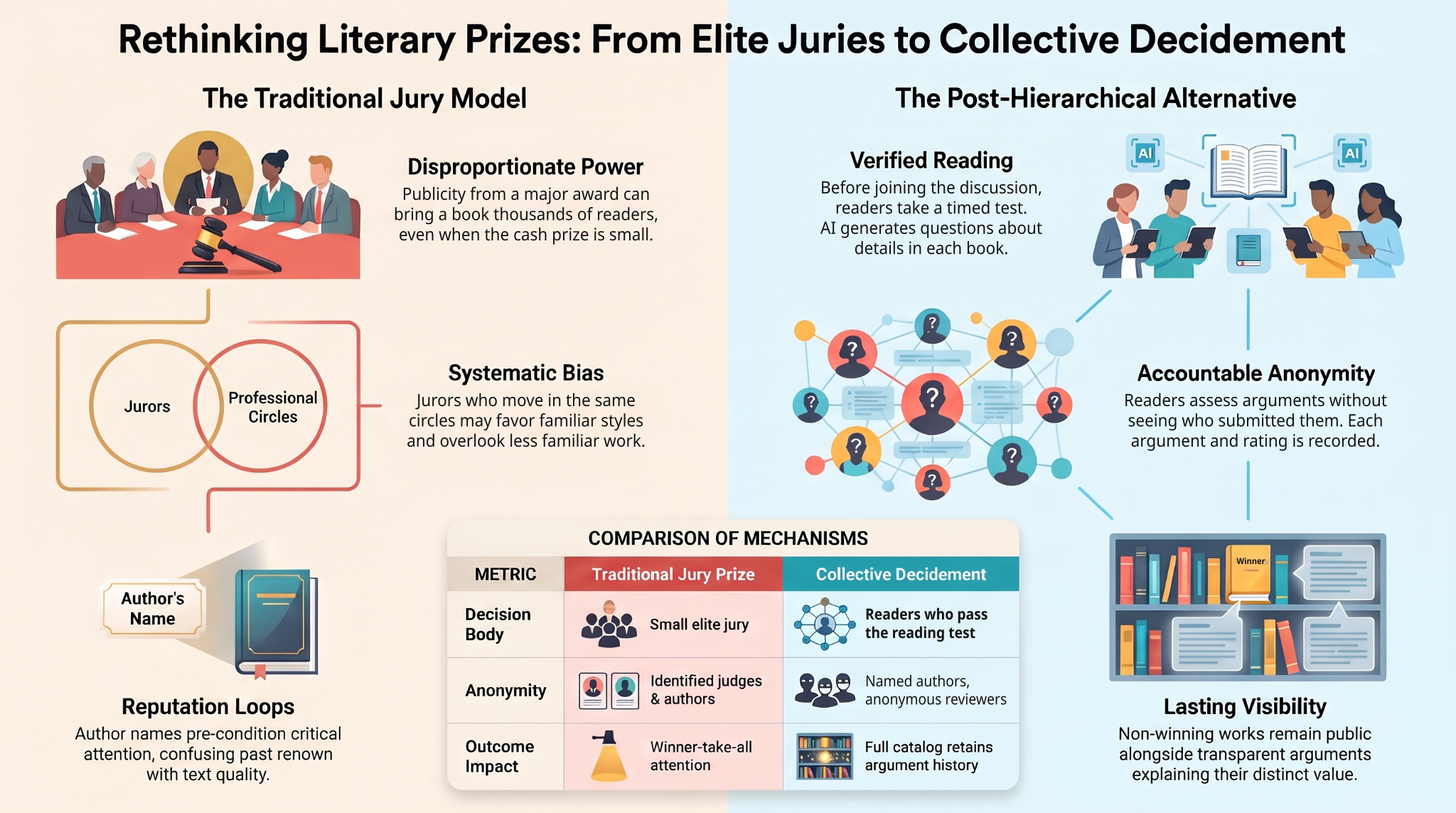
This is where matters. Readers cannot see who contributed a particular insight or rating, but the platform keeps track of each person’s contributions. As readers assess one another’s insights, their judgements form discernible patterns. When several readers, each drawing on their own reading of the novel, give the same observation similar ratings, those ratings cluster. This is . Sometimes two clusters emerge. One group finds an interpretation persuasive while another spots a serious flaw in it. A middling average could conceal how strongly both groups feel.
An anonymous remark on social media can remain an isolated aside. Here, every assessment contributes to a result that others will use. Each reader has a reason to give another person’s idea a fair hearing.
What would readers do beyond casting a vote?
An open online poll would be easy to organise. It might reward the publisher with the largest publicity budget or the novelist whose fans are best at getting out the vote.
A post-hierarchical approach would ask readers to do something different.
would emerge through an exchange on a shared platform. Readers would put forward arguments, encounter interpretations they had missed, assess them and have the chance to reconsider their own. ‘Which book did you like?’ is only the beginning. A more demanding question is what a book makes possible in literature, and what in the text supports that claim.
Does the novel open up an unfamiliar way of experiencing the world? What would go missing if all we had was a summary of the plot? Does a formal experiment earn its place? Might our discomfort with a passage tell us something about our habits as readers?
The term for this shared work of exploring possibilities and choosing among them is . The process is self-organising. Algorithms organise the exchange and calculate the results of the ratings participants give. The readers themselves make the arguments, weigh them and judge the literary value of the work.
What can a disagreement tell us about a novel?
Imagine a narrator who returns three times to the same dinner. One reader finds the repetition tiresome. Another notices an empty place at the table. The first time round, the narrator passes over it. The second time, it gets a mention. Only on the third telling do we learn who should have been sitting there. For this reader, the repetition is what it feels like to struggle to speak about a loss.
Both observations invite a closer reading of the scene. Other participants can return to the three passages, offer an interpretation of their own and weigh the evidence for each. Even after noticing the empty place, the first reader may still think the scene goes on too long. Both readers now know more precisely where they differ and what matters to each of them in the novel.
A single score would lose that distinction. Seeing how the ratings fall, alongside the arguments that drew them, would show which feature of the work divided readers. Collective decidement could help readers understand their differences and, through them, discover what sets a particular book apart.
How could readers award a literary prize?
Anyone who had read the works under consideration could apply. Before joining, each reader would take a . AI would generate questions about episodes, characters or details of the narration, to be answered within a short time. The questions would check whether the applicant had read the works. What someone made of them, and how well they could support a reading, would emerge in the exchange itself.
Discussing the books would be worthwhile in its own right. If the readers came together to award a prize, their assessments would determine the winner under rules published in advance. The organisers could have the pleasure of announcing the readers’ choice at the ceremony.
Such a prize could develop independently. During a transition, a traditional jury and a group of participating readers could consider the same books in parallel, each announcing its own choice. If the two differed, readers would have a good reason to open both books and see what each group had found.
A public library regular could take part alongside a literary scholar. The chance to offer a reading of a novel, and to see what others have noticed in the same pages, would give people another reason to pick it up. Readers of poetry, essays or plays could organise along similar lines. More people could enter the public conversation about literature, and a wider range of writing could find an audience.
What a prize could open up
There could still be one winner and a ceremony to announce it. A post-hierarchical prize could keep much of what makes a literary award a public occasion.
What would change is what happens to all the other books.
A prize could single out one novel while keeping the wider field and the arguments for each book in public view. Readers, librarians and publishers would have reasons to seek out other works long after the announcement. A library reading group might choose the novel that divided its assessors most sharply for its next meeting.
The test would be what happened in practice. Did overlooked works find readers? Did a critic’s standing count for less when an argument was weighed? Could readers still see and understand genuine differences of judgement? A platform would have to earn its claims on all three counts.
The history of the Goncourt poses a question for cultural institutions in Lithuania and wherever literary prizes are awarded. Who gets to turn their judgement of a book into a condition of its being seen by anyone else?
A good prize helps a reader discover a book. A post-hierarchical prize should also make it possible to discover what the choice of a single winner leaves out.
Literary freedom includes the right to write. It also includes the chance to be read without first securing the blessing of a handful of judges.
How a readers’ prize could recognise more than its winner
Sources and further reading
- LRT.lt, 30 October 2026. Prancūzų literatūros Goncourt’ų premija: užkulisiai, akibrokštai ir paradoksai. Original essay on the Prix Goncourt, in Lithuanian.
- culture.lt. Who Will Free Creativity from Conformity? Post-hierarchical analysis 020, on how art is valued and recognised.
- Omnicracy. A platform for collective decidement. This essay considers how readers could use such a platform to explore literary works and award a prize.