POST-HIERARCHICAL ANALYSIS · 014
Why Good Debates Do Not Yet Create Collective Intelligence
A post-hierarchical analysis of Sergejus Stoma and Kamilė Zorytė’s conversation “As Debate Culture Grows, Will Dialogue Be Preserved?”
Debate teaches us to listen, argue and separate an idea from the person defending it. Yet even very good debate usually selects the more convincingly defended position from those already proposed. Collective decision-making aims higher: to discover a solution that neither side may have possessed at the beginning.
Source: Bernardinai.lt
Video: YouTube
SHORT EXPLANATION · 1 MIN 15 SEC
Why do debates not create solutions?
Debate makes disagreement more disciplined, but it still begins with opposing positions. Collective intelligence changes the task from defending one side to discovering an alternative that neither side initially possessed.
- Binary positions compress multidimensional problems.
- Rhetorical strength can outweigh practical value.
- The right to speak does not necessarily confer influence over the decision.
- Collective decision-making separates diagnosis, creation, testing, and evaluation.
Debate as a school of civilised disagreement
In the conversation prepared by Rokas Simanavičius and Juozas Ruzgys, former Youth Debate Association president Sergejus Stoma and debate finalist Kamilė Zorytė consider how debate differs from an everyday quarrel and whether its spread can strengthen a culture of dialogue. They define debate as a structured exchange of arguments: a clear question, opposing positions, an order of speaking, time limits and a duty to respond to the other side.
Especially important is their refusal to reduce debate to victory. Zorytė emphasises curiosity, the examination of a problem and the desire to understand another person. A randomly assigned position, sometimes contrary to one’s convictions, shows that an opinion is not a person’s identity and that an argument can be tested independently of its advocate.
Context: the public sphere rewards conflict rather than understanding
The conversation takes place amid concern about polarisation, abuse, disinformation and social-media bubbles. Digital platforms allow almost everyone to speak, but an abundance of speech does not itself create dialogue. Comments often lack a shared question, verification of arguments, a duty to answer objections or a defined conclusion.
The attention economy rewards emotional intensity. Radical claims, personal attacks and manufactured confrontation travel faster than careful arguments. In political communication, messages are tailored to target audiences, so listeners must assess not only what is said but also to whom, in what context and for what effect. Formal debate restores boundaries, accountability, argumentative sequence and respectful disagreement. Its expansion in Lithuanian schools is therefore an important form of civic education.
What the conversation does particularly well
First, debate is clearly distinguished from quarrelling. Rules oblige participants to hear and analyse the other side.
Second, the argument is separated from the person. An assigned position weakens identity-based attachment to an opinion.
Third, intellectual curiosity is emphasised. This shifts attention from rhetorical domination towards understanding the problem.
Fourth, responsibility for verifying information is acknowledged. Statistics are not reliable merely because they sound persuasive.
Fifth, debate skills are shown to be universal. Constructing arguments and answering criticism matter in science, law, business and everyday decisions.
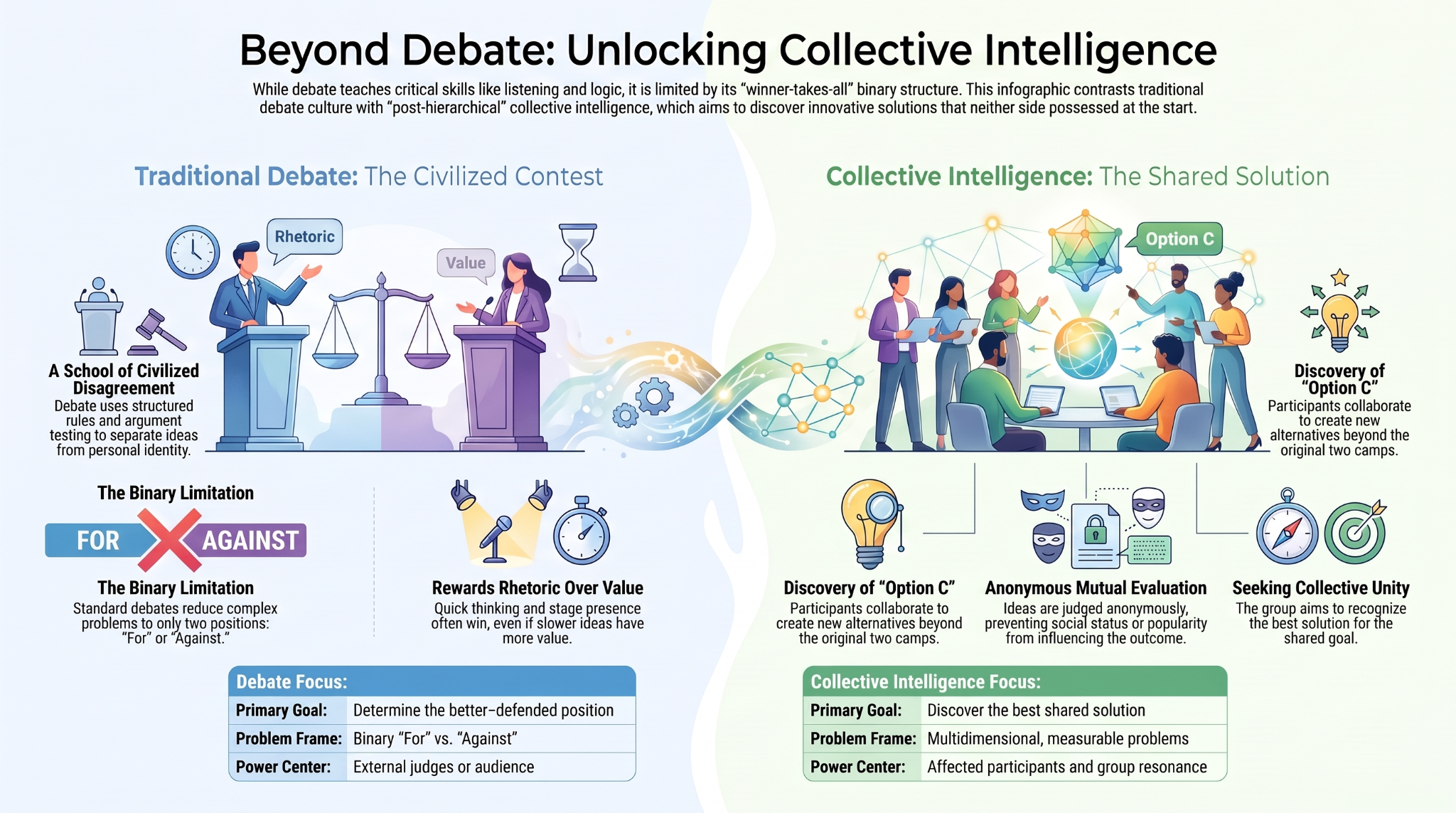
Where the debate argument ends and post-hierarchical analysis begins
If disagreement is framed by rules and people learn to argue, verify information, listen and respect others, a culture of dialogue can grow stronger.
The quality of dialogue does not yet answer who formulates the question, why exactly two positions are selected, who evaluates the arguments and how a shared decision emerges. A civilised contest between positions can remain part of a hierarchical decision system.
Debate improves the quality of competition between positions. Post-hierarchy asks whether competition between positions is the best form for seeking a shared solution at all.
The first limit: two sides reduce a complex problem
Classical debate requires a clear opposition: for or against. This is effective for learning, but social problems rarely have only two meaningful alternatives. Education, cultural funding, migration and urban development form multidimensional spaces of interdependent choices.
When a problem is turned into a duel in advance, participants are encouraged to reinforce an assigned position even though the best solution may lie beyond both. One side defends A and the other B, while the solution may be C, a combination of A and B, or an entirely new formulation of the problem.
The second limit: a rhetorically strong argument is not yet a good solution
Debate rewards coherence, evidence, responsiveness and persuasive speech. These criteria can privilege quick thinking, stage presence and control of attention. A quieter participant or a slowly maturing idea may lose even when its practical value is greater.
In a post-hierarchical environment, the author and status of an idea are initially hidden. The proposal itself is evaluated. Argument testing is separated from social dominance, and an early, imperfect idea can be improved by other participants.
The third limit: the right to speak is not the right to influence the decision
Debate may give both sides a voice, but decision power usually remains with judges, organisers, politicians, managers or the audience majority. Participants supply arguments; an institutional centre decides what to do with them. This is more dialogical, but not necessarily post-hierarchical.
Post-hierarchy begins when those affected by a decision can propose alternatives, evaluate one another’s proposals and genuinely influence the final direction.
Debate is an instrument of decision-making, not the whole process
Debate should not be rejected. It is especially valuable for testing the arguments behind developed alternatives, exposing assumptions and finding weaknesses. The problem begins when this one function is equated with the entire decision process.
Full decision-making contains at least four functions:
- problem diagnosis — identify what is failing and whom it affects;
- generation of alternatives — create more possibilities than the known camps provide;
- argument testing — critically examine evidence, assumptions and consequences;
- collective evaluation — determine which alternatives best serve the shared goal and where polarisation remains.
Debate is strongest in the third function. If it governs the first two, the problem is closed too early between two camps. If it replaces the fourth, judges, a majority or rhetorical advantage decide the outcome.
VIDEO ESSAY · 10 MIN 22 SEC
The limits of good debates
A broader visual explanation of why respectful, evidence-based debate remains valuable yet cannot replace the full architecture of collective decision-making: problem diagnosis, generation of alternatives, argument testing, and collective evaluation.
How dialogue could become collective decision-making
A post-hierarchical process would begin not with “for” and “against” teams but with a shared, measurable definition of the problem. Instead of “should voting be allowed from age sixteen?”, one might ask: “how can competent participation by young people affected by decisions be increased in local governance without reducing decision quality?” No solution is excluded in advance.
Using accountable anonymity, many participants would then submit one alternative or argument each. Before contributing, a participant would evaluate ideas submitted by others. Names, offices and popularity would remain invisible until the process ended, preventing status from substituting for quality.
The aim of evaluation would not be to entrench a personal opinion, but to anticipate what a competent group will recognise as best. This weakens incentives to push private interests; mutual evaluations reveal not only a ranking but also unity, polarisation and resonance.
In debate, a participant asks: how can we defend our position best? In collective decision-making, the question is: what will the group ultimately recognise as the best solution — and what am I still failing to see?
Dialogue is preserved by changing the interaction between differences
Post-hierarchy does not seek unity at any cost. Polarisation is information: it indicates differences in experience, values, interests or interpretations of facts. Such areas can trigger additional fact-checking, new alternatives or temporary competence clusters.
Dialogue is no longer merely a polite tone. It becomes a property of the system: every contribution can be read, evaluated, improved and incorporated into a shared result. No participant can impose it through authority, office, popularity or rhetorical skill alone.
What should change in schools and the public sphere
Debate education should be retained but supplemented by collective decision-making practice. After a “for” and “against” round, students could receive a different task: stop defending the assigned side and jointly create a third, fourth and fifth alternative incorporating the strongest arguments from both sides.
The public sphere should likewise distinguish a programme designed to display positions from a process designed to find a solution. Political debates can clarify differences between candidates, but complex public problems require a broader group, an idea environment based on accountable anonymity, fact-checking and repeated evaluation cycles. Debate would then become one stage of collective decision-making: a stress test for arguments before collective selection.
AUDIO ESSAY · 21 MIN 41 SEC
Why winning the argument is not enough
A spoken exploration of the article’s central distinction: winning a debate identifies the better-defended position, whereas collective intelligence seeks a solution that can emerge only through the interaction and mutual evaluation of many participants.
Conclusion: from a better argument to a better decision
Sergejus Stoma and Kamilė Zorytė rightly defend debate as a school of curiosity, respect, critical thinking and listening. This is highly valuable in a public sphere fragmented by identity conflicts and the attention economy.
Post-hierarchical analysis, however, reveals the next step. Even the best debate retains positional opposition, the influence of rhetorical skill and an external evaluator. It may identify which of two sides is stronger without discovering what neither side had yet formulated.
The future of dialogue therefore depends not only on learning to debate better. It depends on whether, after debate, we can enter a shared decision space instead of returning to our camps. Only then does the other person become not a politely tolerated opponent but an indispensable participant in shared intelligence.
Where debate ends and collective decision-making begins
flowchart TD
A["Public disagreement"] --> B["Structured debate"]
B --> C["Two positions: arguments, rules, respect"]
C --> D{"What is being sought?"}
D -->|"Better-defended position"| E["Debate outcome"]
D -->|"Best shared solution"| F["Post-hierarchical divide"]
F --> G["More than two alternatives under accountable anonymity"]
G --> H["Mutual evaluation in a CI environment"]
H --> I["Unity, polarisation and resonance"]
I --> J["A solution neither side had at the outset"]
classDef debate fill:#f3f1ec,stroke:#9b978f,color:#191916
classDef post fill:#fff8f4,stroke:#a93b2b,color:#191916,stroke-width:2px
class A,B,C,D,E debate
class F,G,H,I,J post