POST-HIERARCHICAL ANALYSIS · 015
Is Leadership by Many Already Post-Hierarchy?
A post-hierarchical analysis of Audrius Šimaitis’s interview on the Soviet medical system and breaking down walls
Terms marked with ? are explained without leaving the article.
Audrius Šimaitis accurately diagnoses the cult of the single leader, the suppression of initiative and the regional monopoly of medical power. Yet replacing one leader with many leaders does not by itself produce shared intelligence. It requires a decidement architecture in which different people’s competence can be combined, while no one’s position grants a prior right to impose the answer.
Source: Bernardinai.lt
SHORT EXPLANATION · 1 MIN 23 SEC
Why does structure beat leadership?
Replacing one powerful leader with many proactive leaders does not yet create collective intelligence. The decisive change lies in the architecture that connects their knowledge without allowing status to control the result.
- More leaders can create more competing centres of power.
- Initiative needs a shared process for diagnosis and evaluation.
- Competence must shape influence without becoming permanent privilege.
- Decidement architecture makes trust operational and verifiable.
Not a bad manager, but a badly designed system
After nearly two decades of work in the United Kingdom, cardiologist and CEO of Klaipėda University Hospital Audrius Šimaitis returned to Lithuania. He presents his earlier emigration not as a clash with a few unsuitable individuals, but with a system. Initiatives were rejected without explanation, while meeting participants were presented with decisions already made and reduced to a formal quorum.
Šimaitis links this arrangement to a Soviet template: an organisation or department must have one leader whom everyone obeys. Such a centre overshadows new ideas and becomes vulnerable to corruption. He describes the Western alternative in opposite terms: everyone is encouraged to become a leader, and the organisation and society become a “community of leaders”.
Context: physical walls reveal institutional topology
The walls in the interview are not merely a figure of speech. When Klaipėda hospitals were merged, the fence separating them was demolished and underground tunnels sealed for decades were reopened. This physical act precisely embodies the organisational problem: units may belong to the same system yet remain separated by information, professional identities, resources and decision channels.
Another wall is geographical. Šimaitis criticises the monopoly of the Vilnius and Kaunas centres over medical training and resource distribution. According to the figures he cites, in 2007–2013 the regions of western Lithuania, home to about one fifth of the country’s population, received 12 per cent of the EU support under review, while disparities in access to doctors remained substantial. He presents Klaipėda’s ability to train residents independently as a third alternative capable of strengthening the region over time.
Thus three levels converge in the text: the psychological legacy of Soviet rule, the internal organisation of a hospital and the national geography of medical power. The same structure recurs at every level: the centre holds the right to decide, while the periphery is left to implement or to ask to be heard.
What is especially valuable in Šimaitis’s position
- The problem is shifted from individuals to the system. This protects us from the illusion that finding a better manager is enough.
- Initiative is linked to responsibility. Freedom is not passivity: it requires the ability to propose, act and answer for consequences.
- Change is understood as creation. Instead of merely fighting “darkness”, Šimaitis proposes cultivating trust, values and managerial capability.
- Regional inequality is shown as a consequence of the architecture of power. Training, finance and access to services are not separate issues.
- Breaking down walls includes professional learning. Young clinicians are encouraged to move between institutions and countries, and knowledge is not treated as the property of a centre.
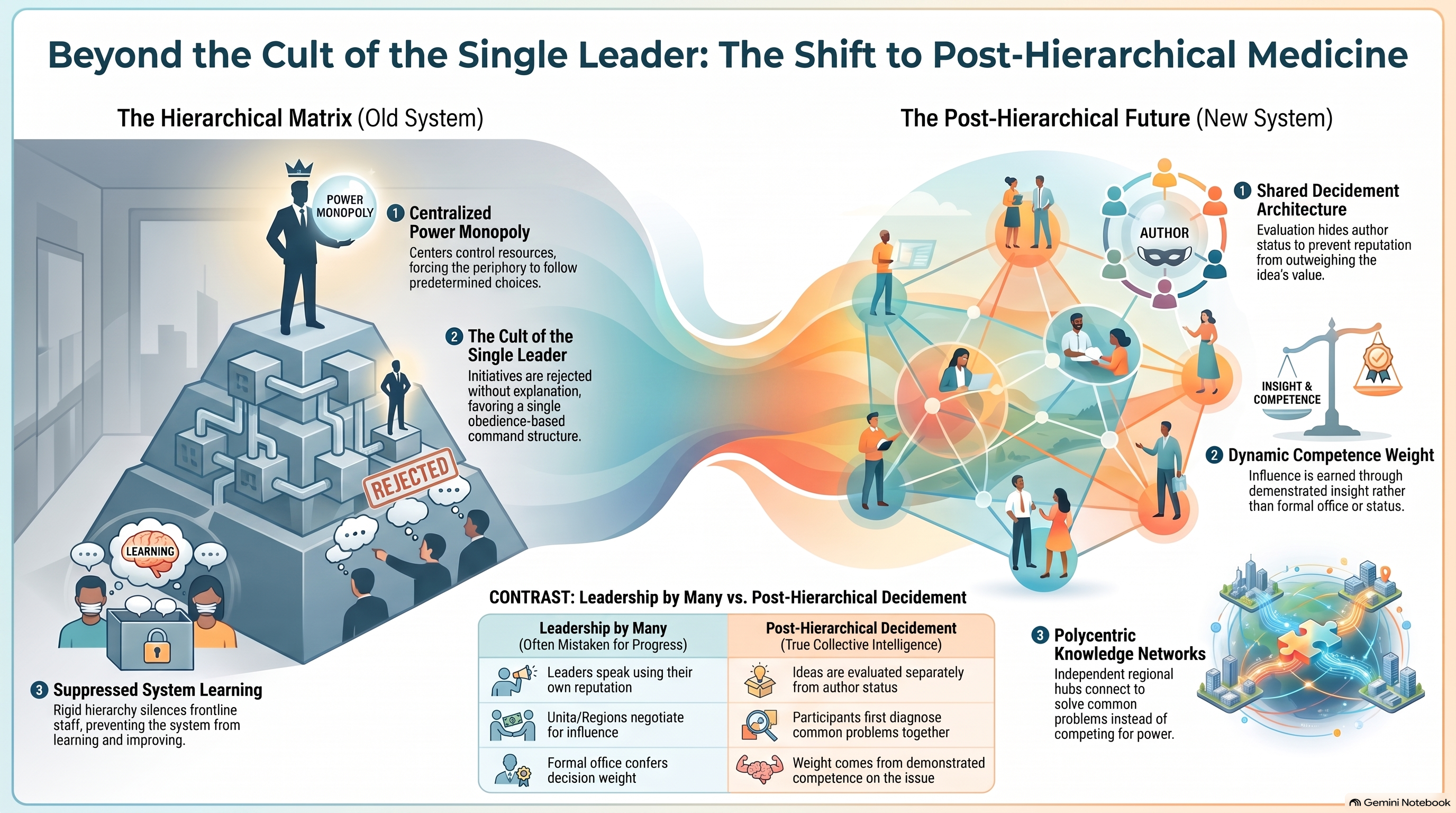
Where does the author’s argument end and the post-hierarchical extension begin?
The cult of one leader should give way to trust, initiative, responsibility and leadership by many. Regions and institutions need greater autonomy.
Many proactive leaders can still compete over budgets, status and professional truths. A process is needed that converts their different experience into shared problem diagnosis, the creation of alternatives and competent mutual evaluation.
“Everyone is a leader” is a normative principle, not yet a decidement mechanism. Unless it is specified how proposals from many people will be collected, tested, compared and converted into a common choice, the old pyramid may be replaced by a field of competing smaller pyramids.
Doctors may defend their specialty, hospitals their funding, universities their flow of residents, regions their infrastructure, and patient groups the services most important to them. More voices do not automatically remove power; they may merely increase the noise of negotiation.
Post-hierarchy begins not when we have many leaders, but when no leader can directly convert status into control over the common decision.
| Leadership by many | Post-hierarchical |
|---|---|
| Many people are encouraged to take initiative | Their initiatives enter a shared, structured decision space |
| Leaders speak in their own names and rely on reputation | During evaluation, an idea is separated from the author’s status |
| Units and regions negotiate for influence | Participants first diagnose the common problem and assess alternatives |
| Formal office confers decision weight | Weight comes from competence demonstrated on the specific issue |
| The majority choice is visible | Alternatives, resonances and polarisation are visible |
| A manager summarises expressed opinions | A manager is responsible for process conditions and implementation |
Post-hierarchy does not abolish clinical responsibility
In medicine, it would be dangerous to interpret criticism of hierarchy as a demand to make every decision collectively. During surgery, resuscitation or emergency care there is no time for prolonged deliberation. Competences, roles, protocols and legal responsibility must be clear. An experienced surgeon and a casual observer do not carry equal epistemic weight.
But it does not follow that the same person or institutional centre should determine the organisation of the entire system. The hierarchy of clinical action and the hierarchy of knowing the system are not the same. The former can protect a patient in particular circumstances; the latter can close information, silence a nurse, resident or patient, and prevent the system from learning.
Post-hierarchical medicine does not abolish the chain of responsibility where life depends on seconds. It prevents that chain from becoming a permanent argument for why the same centres should monopolise strategy, resources and knowledge.
How could collective decidement work in medicine?
A continuous could bring together physicians, nurses, residents, managers, patients, regional representatives, health economists, technologists and other experts required by a specific problem. The objective is not merely to represent groups, but to combine their distributed information.
- Define the problem precisely. Not “poor access to services”, but a measurable gap: where, for whom, which service, for how long and because of which factors becomes inaccessible.
- Separate diagnosis from solution. Participants first identify the problem and its factors and only then propose interventions. A preferred solution is therefore not disguised as a diagnosis.
- Evaluate before proposing. A participant first examines and assesses others’ insights, offering a new proposal only when it adds to the common solution space.
- Hide status while preserving accountability. prevents a professor’s name, hospital size or regional political power from determining an idea’s value in advance.
- Earn competence weight. A participant’s influence on a topic grows when their assessments consistently resonate with competent collective insight, not merely because of office or diploma.
- Return the decision to reality. A measure is implemented with clear indicators, and its consequences become data for the next decidement cycle.
From relocating the centre to a
Klaipėda’s ambition to train residents independently is an important step towards decentralisation. It creates a third capability centre and may reduce western Lithuania’s dependence on Vilnius and Kaunas. Yet decentralisation is not post-hierarchy. If Klaipėda merely reconstructs the same pyramid, the number of centres changes but the decision logic does not.
The post-hierarchical objective would be not to transfer a share of power from two centres to a third, but to build a polycentric system. Vilnius, Kaunas, Klaipėda, regional hospitals, primary care and patient communities would then be not closed territories but nodes contributing different capabilities to a shared knowledge network.
In such a system, the question “who owns resident training?” would be replaced by “what kind of specialist-training network is needed so that everyone in Lithuania can receive the best possible care?” This is not a semantic correction. The first question organises competition among institutions for rights and resources; the second organises joint problem-solving.
Trust must be architectural, not merely moral
Šimaitis rightly stresses a culture of trust. But goodwill alone is insufficient. People distrust a system not only because they distrust one another, but because decision procedures allow the stronger participant to conceal reasons, select convenient facts or simulate consultation after the decision has already been made.
A post-hierarchical architecture makes trust verifiable. Participants can see that an idea was not judged by its author’s name; that alternatives did not vanish in a closed meeting; that disagreement was recorded rather than declared a “consensus”; and that the adopted decision is tied to outcome criteria defined in advance.
This is particularly important in medicine, where information is unevenly distributed. A nurse may be the first to notice a recurring process failure, a patient an invisible barrier to access, a regional doctor a need unseen in the capital, and a specialist a clinical risk the general public cannot assess. Collective intelligence does not equalise these perspectives. It allows them to meet without forcing one to submit to another in advance.
VIDEO ESSAY · 9 MIN 04 SEC
Architecture of trust
A broader visual explanation of why trust in medicine cannot rest on goodwill alone. A post-hierarchical architecture makes it possible to verify how alternatives were preserved, how status was prevented from outweighing ideas, and how the adopted direction will be tested against results.
AUDIO ESSAY · 22 MIN 50 SEC
Why “everyone is a leader” fails
A spoken exploration of the article’s central distinction: distributing initiative among many people is valuable, but it becomes collective intelligence only when their contributions enter a shared decidement process based on accountable anonymity, mutual evaluation and earned competence weight.
Where does the post-hierarchical divide emerge?
flowchart TD
A["Single-leader system"] --> B["Obedience and suppressed initiative"]
B --> C["Šimaitis’s direction: trust, responsibility, leadership by many"]
C --> D{"How do many contributions become a common decision?"}
D -->|"Negotiation by status and power"| E["Competing small pyramids"]
D -->|"Shared decidement architecture"| F["Post-hierarchical system"]
F --> G["Common problem diagnosis"]
G --> H["Alternatives created and evaluated anonymously"]
H --> I["Competence determines the weight of contribution"]
I --> J["Decision tested by results"]Conclusion: demolishing a wall is easier than changing the logic of decision
Audrius Šimaitis’s interview is valuable because it recognises medical stagnation as a systemic rather than personal problem. The cult of one leader, predetermined decisions, regional concentration and fear of initiative are manifestations of the same hierarchical matrix.
Post-hierarchical analysis extends this thought. A single-leader system must be opened to the initiative of many people, but a “community of leaders” becomes collective intelligence only when it has a shared decidement architecture. Otherwise walls may fall only for new offices, new centres and new competing pyramids to arise behind them.
The medical system will change fundamentally not when everyone can call themselves a leader, but when everyone’s competent contribution can shape the common decision—and no one can appropriate it.