POST-HIERARCHICAL ANALYSIS · 020
Who Will Free Creativity from Conformity?
A post-hierarchical analysis of Kasparas Pocius’s article “The Empty Talk of Contemporary Art”
Terms marked with ? are explained without leaving the article.
A jury may give a work an award, a curator may include it in an exhibition, and social media users may share it widely. Yet such recognition does not reveal what viewers, listeners or readers have recognised and understood in the work. Kasparas Pocius’s critique draws attention to this gap between public recognition and the personal experience of art. A post-hierarchical analysis takes the question further: how could people familiar with a work reveal its value together, and how could its creator earn recognition for what the work helps society see? Participants in collective decidement pursue this aim by examining the work closely, substantiating their insights and assessing one another’s ideas.
Publication: Read the original commentary →
SHORT VIDEO OVERVIEW · 1 MIN 29 SEC
The Hidden Trap of Creative Freedom
A short explanation of the relationship between institutional expectations, the pursuit of recognition and creative freedom.
- Artists may internalise assessors’ expectations before choosing a subject.
- Public recognition does not always reveal what audiences understood in a work.
- Collective decidement opens another path to recognising a work’s value.
What does Pocius help us see?
Drawing on Lacan, Pocius asks whether artists recognise their own desires or speak in a voice supplied by institutions and public opinion. He connects authenticity with an awareness of one’s own lack, and a possible way forward with speaking for oneself and practising self-irony. [1]
Context: anticipating recognition
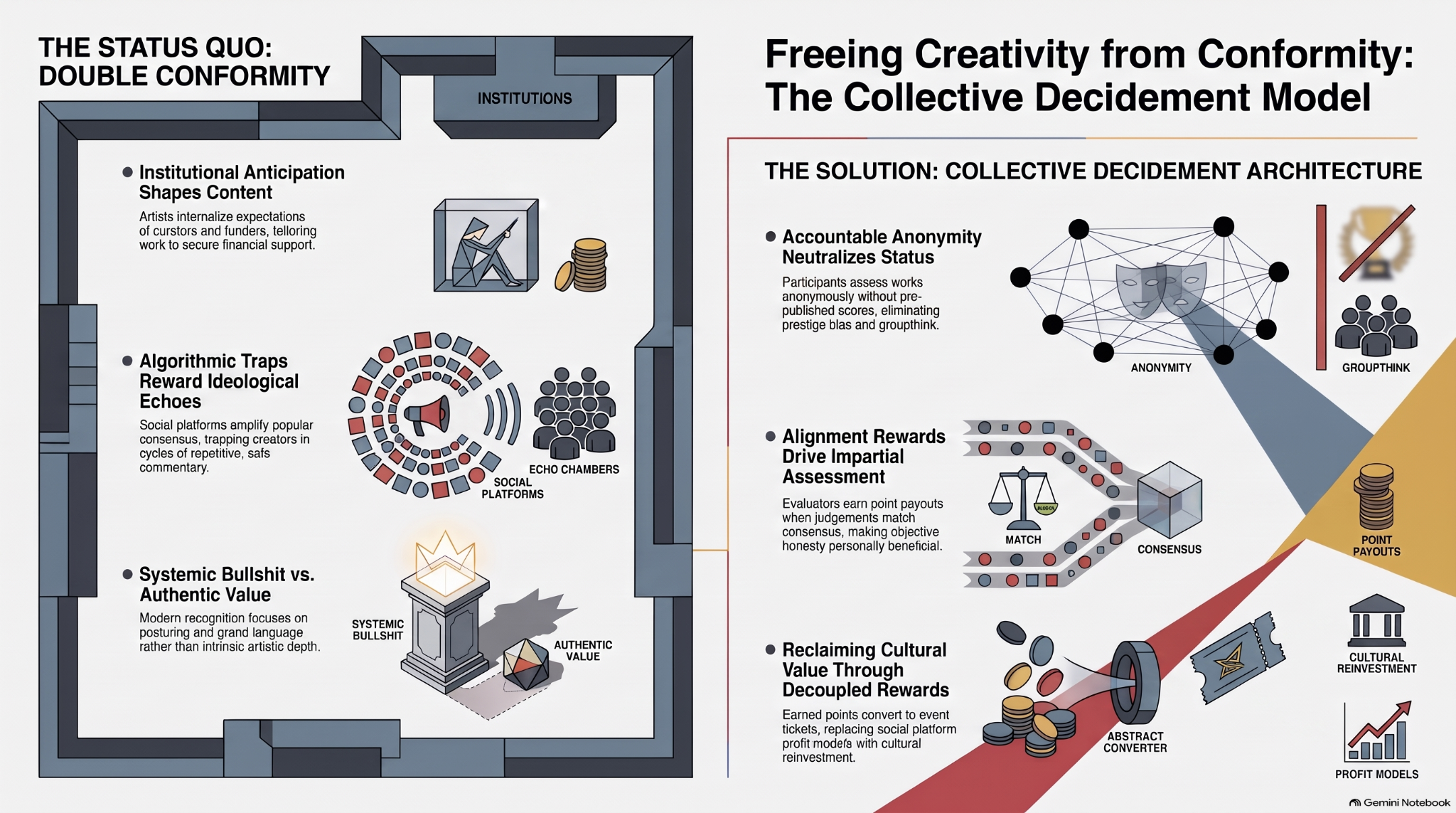
An artist’s conformity to institutional expectations rarely begins with a direct instruction about what to create. More often, artists themselves sense which themes, words and problems will win the approval of curators, juries and funders. Their recognition and financial support depend on the decisions of these people and institutions. Over time, artists begin to see their own ideas through the eyes of imagined evaluators. They may be sincerely interested in a chosen subject while failing to notice how much the wish to secure support has shaped that choice.
Under these conditions, cultural institutions’ decisions overshadow the audience’s assessment even before a viewer encounters the work. Juries and curators select the works the public will be able to see, while institutional presentations explain why those works are considered significant. A viewer may express an impression in a discussion after a premiere or in a comment, but an isolated response does not yet constitute a shared, reasoned assessment of the work. Cultural organisers can count visits, but attendance figures do not reveal what the audience understood in the work. Audiences themselves lack a space in which viewers, listeners and readers can develop their insights, assess one another’s arguments and thereby help establish the work’s value.
On Facebook or Instagram, artists and people commenting on their work face an additional incentive: to anticipate which opinions will appeal to their followers and like-minded people and circulate more widely. Meta explains that its platforms’ ranking systems take predicted user reactions and feedback into account. [2] A post-hierarchical interpretation of this interaction reveals a double conformity: people expressing an opinion may adapt both to their group’s expectations and to the platform’s incentives for visibility. They learn to write in ways that win their followers’ approval and encourage algorithms to show their posts to as many people as possible.
A social media user can thus become trapped in a cycle. Approval from like-minded people increases a post’s visibility, and the author may take that greater visibility as proof that their opinion is correct. To retain the audience’s attention, the same person repeats ideas that have already won approval and relies less and less on personal experience. The post-hierarchical question then becomes specific: under what conditions would people benefit from independently assessing a work and the insights of those discussing it, even if their judgement displeased their peers?
What makes Pocius’s diagnosis valuable?
The appearance of freedom can conceal conformity
Artists may choose a distinctive form of expression while still following institutional expectations. Over time, they may mistake those expectations for their own convictions.
The commission can enter desire itself
Artists take institutional priorities into account as early as the choice of subject. An anticipated judgement by a jury or curator thus influences a work before it is finished.
Public visibility does not in itself bring freedom
People presenting themselves on social media may increasingly adapt to their audience’s approval and drift away from what they themselves experience or think.
Conformity has ethical consequences
Pocius connects double standards and indifference to human suffering with alienation: people excuse conduct within their own group that they would condemn in another. [1]
The post-hierarchical distinction: who will hear a voice of their own?
Artists recognise an alien voice within themselves, learn to speak authentically and become able to laugh at themselves.
People familiar with a work offer reasoned insights and assess one another’s ideas within a single collective intelligence (CI) platform. Together, they reveal the work’s value and earn rewards for well-founded, impartial contributions.
An artist’s personal sincerity does not guarantee that their work will reveal an experience or an aspect of reality that matters to society. A work need not raise a social problem: an artist may give a feeling a new form, expand perception or open up a previously unnoticed side of life. Yet the artist’s sincere commitment to an idea does not, by itself, answer what the work enables an audience to experience or understand.
Artists may sincerely repeat the assumptions of their professional environment and seek recognition without noticing whose experience such work leaves out. For example, if an artist avoids social themes that would make their supporters uncomfortable, people facing those problems lose an opportunity to be heard through the work, and the audience loses an opportunity to understand their situation better. This can be the cost of conformity: society sees in the work only the part of its life that the people and institutions supporting artistic creation find it comfortable to acknowledge.
In critical art, an artist gives a work depth by recognising a specific contradiction. An institution may proclaim creative freedom yet support only works that fit its priorities; a professional community may defend its members’ right to speak while ignoring opponents who have the same right. In both cases, a person’s opportunity to be heard depends on conformity to an influential group’s expectations. An artist who has experienced this selection can show how it works. The audience can then recognise a broader obstacle in the artist’s personal story: other artists and members of society face similar restrictions on expression when their views do not fit an institution’s or a group’s position.
Cultural institutions may urge artists to be themselves while giving the most favourable assessments to works that meet the institutions’ own expectations — artists quietly adapt. Post-hierarchical analysis takes this paradox further by asking how artists could earn well-founded recognition directly from people familiar with their work. Collective decidement offers such a path to recognition. Within a shared platform, participants draw on their knowledge and experience to assess what a work opens up for its audience and how the artist achieves it.
“Šūdmala”: from self-irony to a different basis for recognition
Pocius concludes his discussion with Goda Simonaitytė’s production “Šūdmala”. In his analysis, self-irony helps artists recognise how the pursuit of recognition permeates their identity. Viewers, too, are invited to see their own part in creating and sustaining the myths of the art world. [1]
In its introduction to the production, OKT raises questions about the influence of an artist’s name on the assessment of a work, and about language that can conceal a lack of artistic substance. The creators were inspired by Harry G. Frankfurt’s (1929–2023) concept of bullshit. [3] Frankfurt used the concept to describe a speaker’s indifference to truth when the main aim becomes the impression made on the listener. [4] In the assessment of art, this distinction allows us to ask how far grand talk about a work is actually grounded in what the artist has done.
Post-hierarchical analysis follows Pocius’s direction further here. Artists may recognise their conformity and laugh at it, yet after the premiere they will still have to seek funding and recognition. Viewers may recognise the absurdity of the art market but choose their next work by a famous name or an institutional recommendation once again. Even a perceptive critique of the system may gain recognition under the very rules it exposes. Self-irony gives people some distance from their role; the system of recognition does not thereby change.
“Šūdmala” thus leads this analysis to a specific task: discussion of the experience of art needs conditions in which people benefit from grounding their impressions in an analysis of the work and considering others’ arguments. The architecture of collective decidement connects this possibility with participants’ anonymity, their mutual assessment and rewards for impartial contributions. The audience’s ability to recognise the theatre of recognition can then become an ability to make its own well-founded assessments of art.
How the experience of a work becomes a shared assessment
Collective decidement is the process of proposing and assessing ideas through anonymous interaction within a single CI platform. People knowledgeable about a shared subject or field of art join a — a group of participants and their shared workspace. In a particular project, these people examine a work they have themselves seen, heard or read. Their knowledge and their experience of art meet in the same assessment.
Each project focuses on one work or a clearly specified aspect of it. In one project, participants may discuss a chosen production in depth; in another, a particular concert. Within a literature cluster, separate projects can examine the characters, plot and language of the same book. Every idea submitted within a project must address that project’s question.
Suppose participants are assessing a single production. One argues that the final silence reveals a character’s fear and connects it to earlier scenes. Another explains why a recurring scene weakens the dramatic tension. Each idea makes one clear point about a strength or weakness of that production and provides grounds for it. Other participants assess the accuracy and significance of these insights and may offer their own. A shared assessment of the work thus grows out of arguments about specific artistic choices.
An important part of this process is . The creator of the work under analysis may be known, while the participants who propose and assess ideas in collective decidement remain anonymous to one another. The platform records their contributions without revealing their identities. Participants do not know the cluster’s full membership, and while assessing ideas they cannot see a pre-published aggregate score to which they could adapt.
The model’s rests on removing the conditions for interest groups to form within participants’ interactions, and on an incentive to assess an idea on its merits. A well-known artist’s name therefore does not in itself preclude an objective assessment. A participant may dislike a work yet recognise its craftsmanship, or identify a flaw in a work they like. Differences in taste remain, but the artist’s recognition acquires an explicable basis.
People determine the value of the work and of the ideas submitted about it. Algorithms aggregate participants’ assessments, take their specialisation weights into account and calculate points. This matters to the problem Pocius examines because artists receive a reasoned response from an audience familiar with their work — a response that can provide an independent basis for recognition.
When impartiality becomes a personal interest
Participants’ anonymity is complemented by reward rules: participants earn the most points when their assessments are close to the overall assessment that emerges through an honest process. Even if a participant suspects that a weak idea came from an acquaintance or a like-minded person, it is more beneficial to assess its merits accurately. Culture.lt discussed this reversal of incentives in Post-hierarchical Analysis 018:
“participants may seek to maximise their own points, but doing so makes it beneficial for them to assess impartially.”
“When Democratic Communication Becomes a Struggle, Who Can Change the Rules of the Game?” [5]
means that the pursuit of personal benefit supports a shared effort to understand the work. The participant’s point of reference — — is not known in advance. In seeking to “hit” it, participants help bring it into being through their own assessments. They have to rely on the work, on arguments and on consistent principles of assessment, because there is no published majority answer for them to repeat.
Here a direct connection emerges with Pocius’s doubts about the independence of human desires. Frankfurt helps take this question further by distinguishing a : a person can assess their own desires and want precisely the desire they endorse to determine their action. [6] An art evaluator may want to defend a favourite artist while also wanting honesty to guide their judgement. The rewards of collective decidement give practical support to this second aspiration.
Post-hierarchical architecture thus carries the question of authenticity into the everyday conditions of action. The structure of interaction itself supports participants’ commitment to independent judgement: they benefit from acknowledging a well-founded insight even when it unsettles their sympathies. Such an audience gives artists an opportunity to earn recognition for the experience their work reveals and for its artistic precision. Financial or institutional approval then ceases to be the only reference point by which artists can judge the value of their work.
When points bring people back to culture
Participants in collective decidement can exchange the points earned through valuable contributions for a theatre or concert ticket, or a book voucher. They receive a tangible reward for their efforts to understand and assess impartially. Having helped the project’s participants understand one work better, they gain further opportunities to encounter another.
As a new social technology, the collective decidement platform thus connects an understanding of culture, personal benefit and the recognition of social value. A participant’s insights into one work can open the way to another cultural experience.
Decommercialisation in this context means moving away from the social media profit model in which platform operators use people’s attention and interactions to increase their own revenue. Collective decidement changes that direction: participants themselves receive the reward for their intellectual effort and impartial assessment.
Participants’ relationship with culture retains a commercial dimension. A ticket or voucher has monetary value, but participants earn it by recognising a work’s value and helping others in the project understand it. Recognising culture and assessing it on reasoned grounds become rewarded activities: participants receive an economic benefit for contributing to a shared understanding of the work.
This interaction gives artists an incentive to create independently. Their work can earn recognition because decidement participants familiar with it have recognised a precisely revealed social problem, a strong artistic form or a significant question. Artists thus have grounds to expect that an attentive view of reality will be valued without conformity to an institutional commission. Participants earn points for their contributions, while the artist receives a reasoned assessment of the work and recognition based on it.
Universal principles and creative freedom
The collective decidement model rests on the premise that people free from group pressure can recognise universal values and principles. Participants recognise human dignity, freedom and life as values regardless of the group to which a person belongs. This premise provides a shared reference point for assessment: participants must apply to themselves and their peers the same principles they apply to other groups.
Artists retain freedom of artistic expression. The grotesque, fiction or a disturbing image can become a way of revealing human experience and social contradictions. In their assessments, participants consider the work’s context and examine the purpose and effect of its artistic means. A work need not become a declaration of moral approval for an audience to recognise its value on reasoned grounds.
A culture in which seeing more is worthwhile
Collective decidement connects artists’ courage to create independently with the audience’s capacity for attentive assessment. Artists can earn recognition for what their work reveals, while decidement participants earn rewards for their efforts to understand and assess it impartially. Artists gain a path to recognition through the decidement of people familiar with their work. Viewers, listeners and readers, in turn, become active participants in establishing the work’s value.
It is worth the artist’s while to see more deeply when it is worth society’s while to understand more deeply. Under these conditions, artists can find an attentive audience, and audience members can put their experience and knowledge to meaningful use. By examining a work together, people learn to understand more precisely both the artist’s achievement and the life of society revealed within it.
From a critique of conformity to a different basis for recognition
Sources and references
- Kasparas Pocius. “The Empty Talk of Contemporary Art”. LRT.lt, 2026-10-24.
- Meta. “How AI Influences What You See on Facebook and Instagram”, 29 June 2023. The platform’s explanation of content ranking.
- Oskaras Koršunovas Theatre. “Šūdmala”. Official introduction to Goda Simonaitytė’s production; premiered on 13 October 2026.
- Harry G. Frankfurt. On Bullshit. Essay hosted on the California State University, Dominguez Hills website; published as a standalone book by Princeton University Press, 2005.
- culture.lt. “When Democratic Communication Becomes a Struggle, Who Can Change the Rules of the Game?”. Post-hierarchical Analysis 018; sections on the reverse prisoner’s dilemma and the emergence of collective wisdom. Quotation translated from Lithuanian.
- Harry G. Frankfurt. “Freedom of the Will and the Concept of a Person”. The Journal of Philosophy, 68(1), 1971, pp. 5–20. Copy of the original on the Utrecht University website.