POST-HIERARCHICAL ANALYSIS · 019
Who Will Deschool the Educators?
A post-hierarchical analysis of Gintautas Mažeikis’s essay “Enlightenment and the Deschooling of Society”
Terms marked ? are explained without leaving the article.
Gintautas Mažeikis asks why education that promises independence so often cultivates obedience. Yet leaving school does not by itself end subordination. A post-hierarchical continuation changes the foundations of education: people learn to understand, act responsibly, and shape the conditions of shared life.
Publication: Read the original commentary →
SHORT VIDEO OVERVIEW · 1 MIN. 30 SEC.
Why Traditional Schooling Cultivates Obedience
A short overview asks why education that promises independence so often trains learners to follow instructions.
- Knowledge transfer can coexist with the reproduction of obedience.
- New educational settings do not automatically change the subordinate relationship.
- Post-hierarchical education develops independence and rethinks the teacher’s role.
What does the commentary reveal?
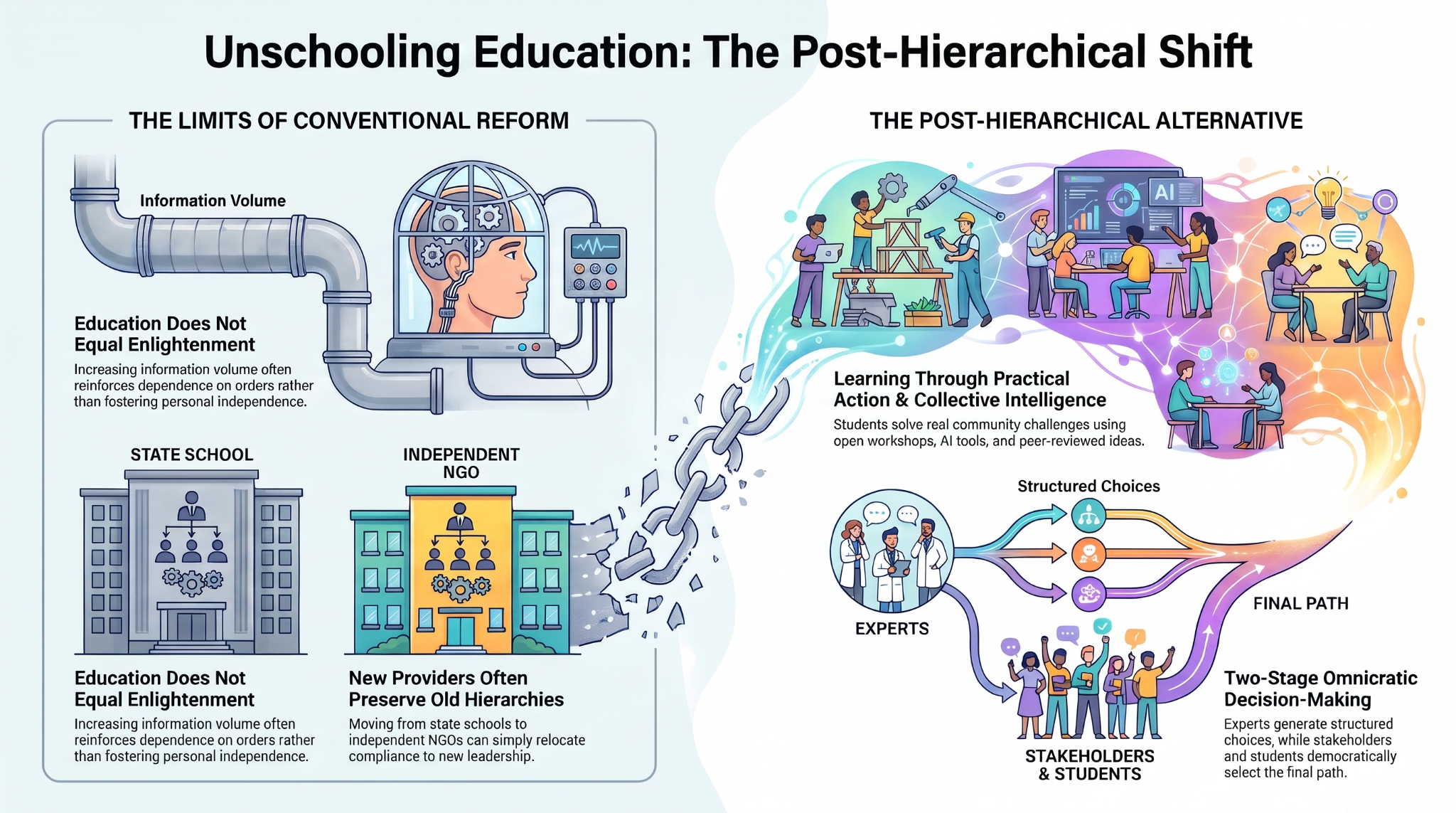
Mažeikis distinguishes Enlightenment from institutional education: the transmission of knowledge can cultivate independence, but it can also train people to live by instructions. Drawing on Illich, Freire, and Giroux, he links schooling with the reproduction of obedience and the demands of the market. He proposes giving greater opportunity and resources to independent, non-profit learning environments such as museums, non-governmental organizations, and creative associations.
Context: where does reform end?
When an existing social architecture, such as representative democracy, is treated as the final form of social organization, critics are left to “cure” it: remove corruption, narrow the distance between power and the public, restore trust. Yet the divide between those who decide and those for whom decisions are made remains beyond the scope of reform. Education can be treated similarly: bureaucracy can be reduced and providers given greater freedom, while their unilateral right to define the kind of person to be formed remains intact.
Non-profit status does not undo this relationship. An organization may be independent of a ministry and still expect participants to conform to its leadership’s worldview. It may encourage creativity while preparing some people to set the direction and others to carry it out. The language of liberation can then help hierarchy renew itself: those in subordinate positions receive more opportunities, while subordination itself persists.
The proposal makes a case for institutional plurality, but does not develop a mechanism to prevent obedience from taking root in new settings. This limit can be examined without attributing hidden motives to the author.
What is valuable in this diagnosis?
Education is not automatically Enlightenment
Knowledge can grow alongside dependence on instructions. This distinction lets us judge education by whether people become more independent, rather than only by their ability to complete assigned tasks.
The causes of obedience extend beyond school
A teacher’s efforts to cultivate independence meet economic and administrative expectations. The problem cannot be solved merely by demanding better teaching methods.
Searching for alternatives is a condition of freedom
The commentary challenges the claim that no alternatives exist. Seeing more than one possible course of action creates a way out of imposed necessity.
Learning has no single address
Attention to museums, associations, and other settings broadens educational possibilities. A post-hierarchical continuation builds on this opening while asking how the same subordinate relationship can be prevented from reappearing elsewhere.
The post-hierarchical distinction: a different institution or a different purpose for human beings?
Weaken the monopoly of the industrial education complex by expanding the opportunities available to independent educational institutions.
End the need to prepare people for subordination: ground learning and its organization in independent inquiry, responsibility, and collective decidement.
What follows is an independent post-hierarchical proposal. It begins with . People are not assigned in advance the role of executor or future ruler. Their abilities are developed so they can understand the world and act meaningfully within it.
This freedom has substance. Universal values formed through social experience—human dignity, freedom, and the preservation of life—describe what we seek to protect for everyone. Universal principles, as used here, are conditions of reality and coherent reasoning that do not depend on human agreement: for example, conservation of energy in physical processes or the law of non-contradiction in classical logic. Values orient our aims; principles help test whether our understanding and methods are sound. Neither replaces the other.
Understanding does not automatically mean being able to act. Will must also be cultivated: the will to continue meaningful work, overcome difficulty, and acknowledge error. These capacities grow when people understand why their effort matters and can experience its results.
Why is growth in a person’s own interest?
If independence is expected only in carrying out other people’s tasks, learning easily becomes a matter of external reward or punishment. A post-hierarchical perspective connects learning with a real capacity to act: a person who understands more can find better solutions, assess others’ proposals more thoughtfully, and influence shared conditions. Self-education expands that person’s own possibilities for action.
An interest in maintaining one’s health arises from the same conditions of independence: physical and mental health help sustain attention, learning, creativity, and participation. Volunteering lets people use their abilities to benefit others, experience the meaning of their contribution, and strengthen the community they belong to. Personal benefit and the common good can reinforce one another.
This relationship cannot be created by simply urging people to be better. It requires accessible opportunities to act, visible contributions, and participation with real effects. Learning, caring for oneself, and helping others can then become chosen practices of life rather than another list of compulsory tasks.
How do we learn when the teacher is no longer the sole centre?
Knowledge can come from books, films, AI, practical activity, and . De-hierarchizing education does not reduce the teacher to an information provider or task supervisor. It creates more room for the teacher’s curiosity, subject knowledge, will, and the values expressed through their actions.
As robots and AI take over more tasks, some activities disappear from everyday life. People may no longer have the chance to repair, assemble, or test something with their own hands, even though such experiences help them understand how things work and what knowledge is needed to change them. A post-hierarchical society could create workshops where people practically explore what they no longer encounter in an automated environment: building, growing, repairing, measuring, and observing the properties of materials and living systems. These workshops would not train a workforce to compete with robots; they would let people understand the world through action and develop independence and responsible judgment.
In such a workshop, learners might create a device the community needs: seek physics knowledge in books, films, AI, and other sources; anonymously propose technical solutions and assess others’ ideas on a shared CI platform; then test the proposals in practice. The teacher is not the only source of knowledge. A teacher can spark a question, reveal the depth of inquiry, and create a meaningful experience. Their example helps learners grow without requiring them to become a copy of the teacher.
How could decisions about organizing learning work?
Two processes must be distinguished. Collective intelligence can be used in learning a subject. Decisions about which forms of learning suit different age groups, how to fund them, and how to make them accessible belong to a separate process of deciding how learning is organized.
Stage I. Specialists develop alternatives
, specialists first develop and assess possible solutions in a collective-intelligence environment.
Stage II. Stakeholders choose the direction
The wider public, including children who have passed relevant knowledge tests, chooses among the proposals. Experts do not gain a monopoly over the final choice, and the public is not asked to decide unfamiliar matters without well-prepared options. People assess proposals in both stages; algorithms only calculate the results of those assessments.
This addresses a problem left unresolved by institutional reform: an independent organization does not become the new sole owner of educational direction. Expertise is needed to discover possibilities, stakeholders’ will to choose an acceptable course, and practical experience to test and revise that choice.
What would education look like in a post-hierarchy?
Imagine a community asking how young people could better understand energy production. Subject-matter experts—physics and technology specialists, teachers, and practitioners—first propose and assess possible ways of learning. Learners might use a laboratory, workshop, museum, or company; or create a learning enterprise in which they design a small device together. Even if robots could already do all the manufacturing, human participation would still matter: it helps people understand the process, consider its consequences, and experience responsibility for a shared result.
Experts make alternatives visible and explain their conditions, but do not decide which experience everyone must undertake. Families, learners, teachers, and the wider public then choose a direction they find acceptable. Children’s participation depends on age and preparation; tests can help determine which questions they are ready to decide.
Within the chosen setting, learning follows its own process. Books, films, AI, the teacher’s example, and practical experiments become different sources of understanding. Learners propose technical solutions and assess one another’s ideas on a CI platform; practical tests show what works and what remains to be understood. The teacher sparks questions, shares expertise, demonstrates how to examine one’s own thinking, and embodies values through action. The teacher is not the sole source of knowledge, yet their human presence can give a learner the courage to learn.
Two processes meet without merging: collective intelligence supports learning, while omnicratic decidement determines the conditions in which learning takes place. The first develops the capacity to understand and propose; the second lets society choose how to organize that growth. Institutions and specialists remain, but their expertise enables people to act instead of replacing their choice.
A deschooled society need not be governed like a classroom
The commentary helps us see why schooling can contradict Enlightenment. A post-hierarchical continuation goes further: when social organization rests on people’s ability to discover and choose solutions themselves, the need to educate obedient executors diminishes. Independence gains real room for action.
The teacher’s freedom, the learner’s growth, and society’s capacity to decide become parts of one transformation. The promise of deschooling is fulfilled when society no longer needs to reproduce the relationship between those who lead and those who are led. This architecture must be tested in practice, by people’s growing capacity and the results of the decisions they choose.
From the critique of obedience to two different paths
flowchart TD
 A["Education cultivates obedience"] --> B["Mažeikis: more independent educational institutions"]
 B --> C{"Is subordination eliminated?"}
 C -->|"Only providers change"| D["Obedience may reappear elsewhere"]
 C -->|"Post-hierarchical continuation"| E["Human growth instead of an assigned role"]
 E --> F["Independent learning: values, principles, and will"]
 E --> G["Separate omnicratic decidement on learning conditions"]
 F --> H["Capacity to act and change shared conditions"]
 G --> H
 classDef post fill:#fff8f4,stroke:#a93b2b,color:#191916,stroke-width:2px
 class E,F,G,H post